Research Library · Foundations
Understanding Laboratory Testing
A research peptide usually arrives as a small amount of white powder in a vial. Laboratory testing is how you find out what that powder actually is. This guide explains the common tests in plain language and how to read a report with a careful eye.
What a Certificate of Analysis is
A Certificate of Analysis, or COA, is a report from a laboratory describing the tests it ran on a particular sample and the results it found. A useful certificate names the sample, the laboratory, the date of analysis, the methods used and the results. Some independent laboratories also print a verification code that lets anyone confirm the report on the laboratory's own website.
Pepvela publishes third-party certificates on its Documentation page exactly as they were issued, and links a certificate to a product only when it matches that exact compound and strength. Each certificate applies only to the sample it names.
Why batch numbers matter
Peptides are made in batches, also called lots. Two batches of the same peptide come from separate production runs, and their results can differ. A certificate describes the sample that was tested, which in turn represents the batch it came from.
When you read a certificate, check whether it names a batch or lot, and whether that matches the material it is meant to describe. A certificate for one batch says little about a different one.
Identity, purity and quantity: three different questions
Testing a peptide comes down to three basic questions, and each needs its own kind of measurement.
- Identity: is this the right molecule? Mass spectrometry is the usual tool.
- Purity: of the peptide material present, how much is the intended peptide and how much is closely related impurities? High-performance liquid chromatography (HPLC) is widely used to separate and measure them.
- Quantity: how much peptide is actually in the vial? A dried peptide powder can also contain water and counter-ions, such as acetate or trifluoroacetate, left over from manufacturing, so the weight of the powder is not the same as the weight of the peptide. This is why peptide content is measured separately from purity.
A sample can do well on one question and poorly on another. A very pure sample of the wrong peptide is still the wrong peptide.
HPLC in plain language
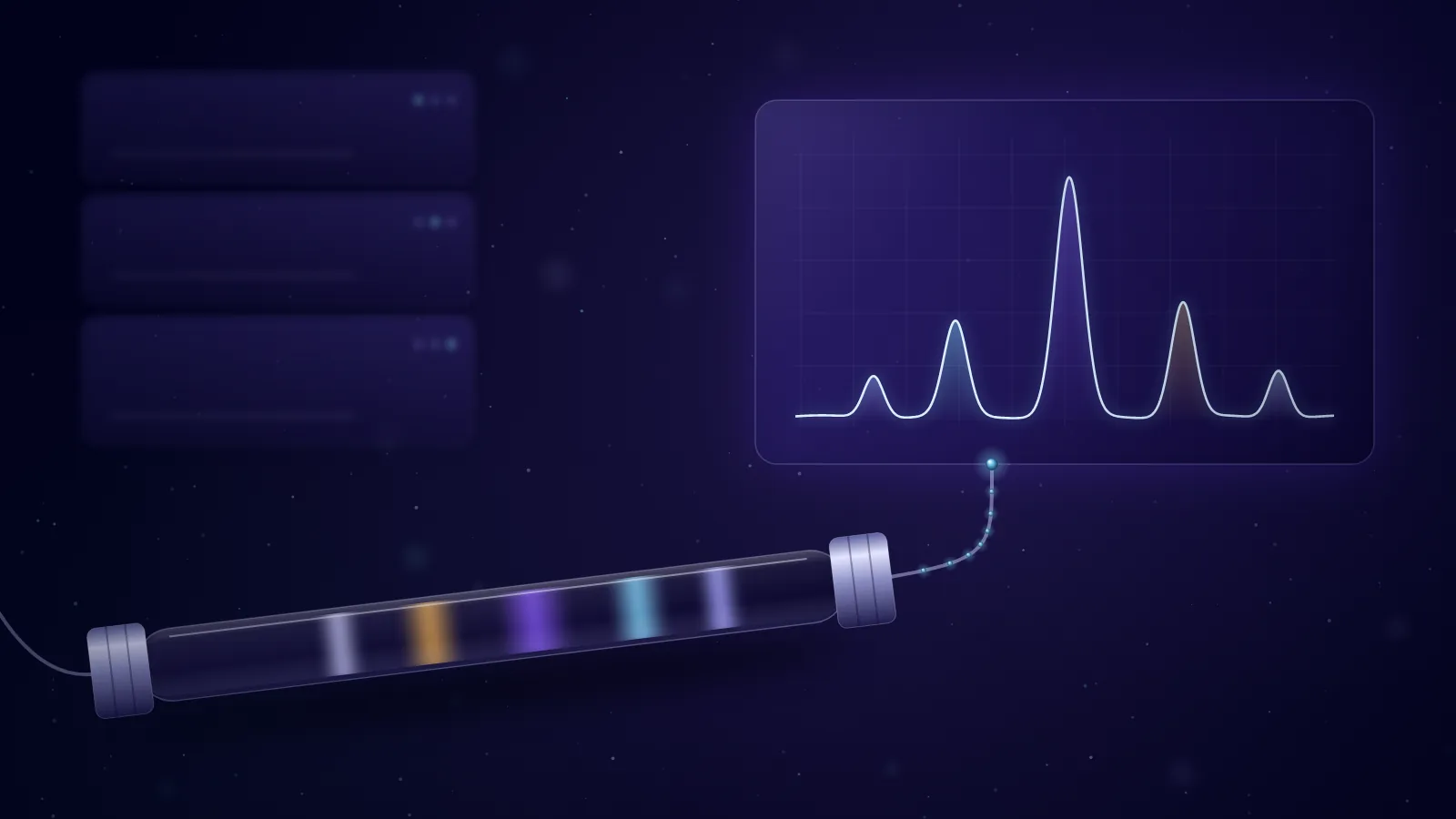
In HPLC, a dissolved sample is pumped through a narrow column packed with fine material. Different molecules cling to that material by different amounts, so they travel through the column at different speeds and come out at different times. A detector at the far end records each one as a peak on a chart called a chromatogram.
Picture runners on a track: everyone starts together, but they cross the finish line at different moments. The main peak is the intended peptide; smaller peaks are other substances, often related impurities such as chains missing an amino acid or chains with a small chemical change. Purity by HPLC is usually reported as the main peak's share of the total peak area.
Mass spectrometry in plain language
Mass spectrometry weighs molecules. The instrument gives molecules an electric charge and measures their mass relative to that charge. Because the expected mass of a peptide can be calculated from its sequence, a measured mass that matches the calculated one is strong evidence that the right molecule is present. Mass spectrometry is very good at identity, but on its own it is not a purity measurement.
Sterility, endotoxin and other contaminants
Some tests look for things that should not be there at all:
- Sterility testing checks whether living microorganisms, such as bacteria or fungi, are present.
- Endotoxin testing looks for endotoxins, fragments of the outer membrane of certain bacteria that can remain even after the bacteria themselves are gone.
- Other contaminant tests can screen for heavy metals or for solvents left over from manufacturing.
Not every certificate includes these tests. If a test is not listed, the certificate does not tell you anything about that question.
Different tests answer different questions
| Question | Common test | A result can tell you | It cannot tell you |
|---|---|---|---|
| Is it the right molecule? | Mass spectrometry | Whether the measured mass matches the expected peptide | How pure the sample is |
| How pure is it? | HPLC | The main peptide's share of the substances detected | The molecule's identity, on its own |
| How much is there? | Content (quantity) assay | How much peptide the sample contains | Its purity or identity |
| Are microbes present? | Sterility test | Whether living microorganisms grew from the sample | Whether endotoxin is present |
| Is endotoxin present? | Endotoxin test | The level of bacterial endotoxin | Whether living microorganisms are present |
Reading a report responsibly
- Does the sample name, including its strength, match what the report is meant to cover?
- Is the laboratory named, and can the result be checked, for example with a verification code?
- Is there a date, and a batch or lot number?
- Which methods were used, and which questions do they answer?
- Are any tests missing? A missing test is an unanswered question, not a pass.
Good laboratories validate their methods, showing that a test measures what it claims to, accurately and repeatably. Even so, a certificate is a snapshot of one sample on one day. Read it as evidence about that sample, not as a guarantee about anything else.