Research Library · Foundations
Peptides Explained
Peptides are short chains of amino acids, the same building blocks that make up proteins. This guide explains what peptides are, how they are put together, where they occur in nature and how research peptides differ from approved medicines.
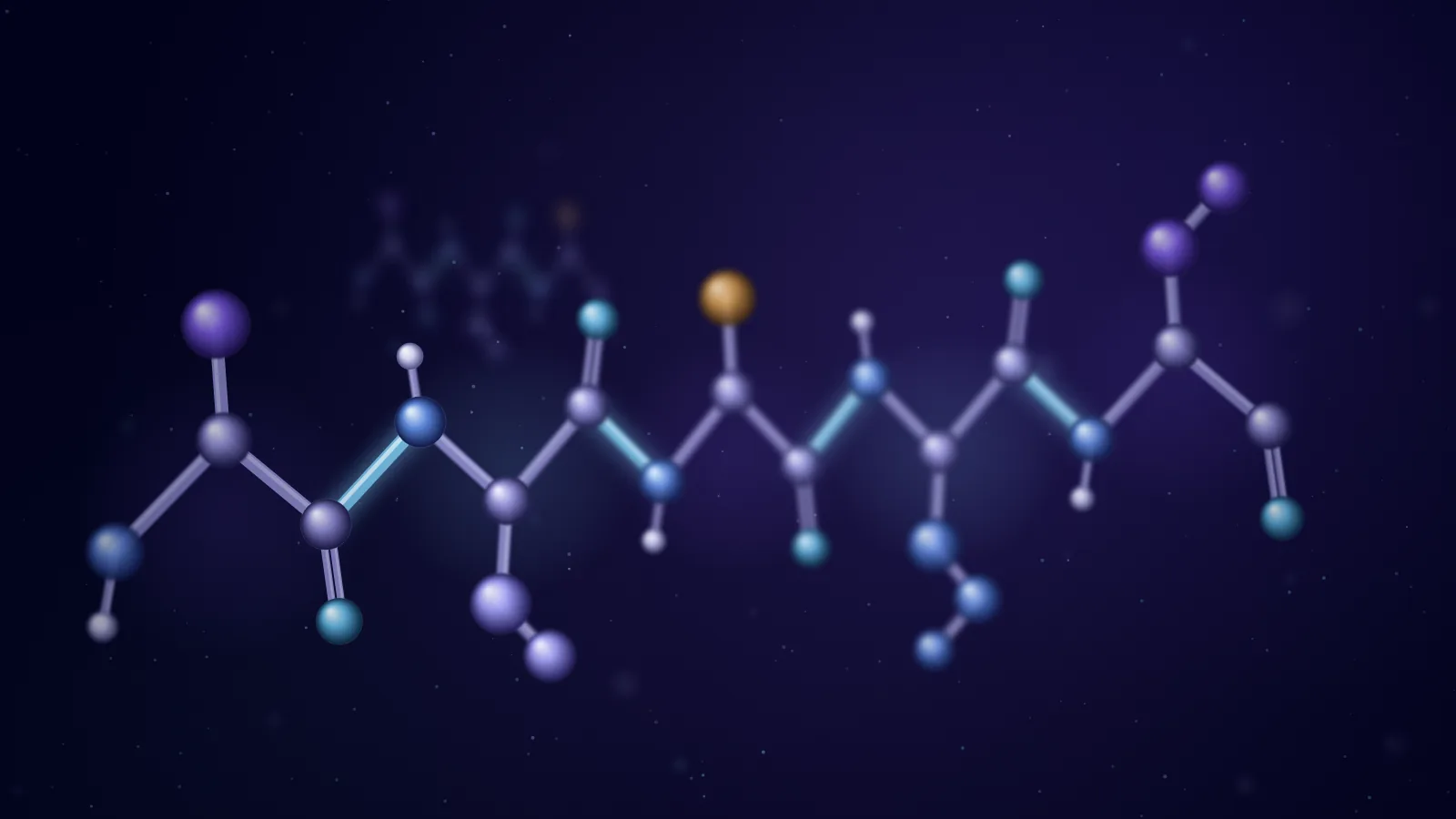
Amino acids: the building blocks
Every peptide starts with amino acids. An amino acid is a small molecule with a shared core: an amino group at one end, a carboxyl (acid) group at the other, and a side chain that gives each amino acid its own character. Some side chains carry an electric charge, some avoid water and some are tiny. Living cells build their proteins from 20 common amino acids.
A helpful comparison is an alphabet. Twenty letters can spell an enormous number of words, and changing the order of the letters changes the meaning. In the same way, the order of the amino acids in a chain, called its sequence, determines what kind of molecule it becomes.
How amino acids link into chains
Amino acids join through a peptide bond. The carboxyl group of one amino acid reacts with the amino group of the next, and a molecule of water is released. Repeat that step and the result is a chain.
Every chain has a direction. One end still carries a free amino group, called the N-terminus, and the other end a free carboxyl group, called the C-terminus. By convention, scientists write a sequence starting from the amino end. Short chains are named by length: two amino acids make a dipeptide, three a tripeptide, and longer chains are called oligopeptides or polypeptides.
Peptides and proteins: mostly a matter of size
Peptides and proteins are built in exactly the same way. The main difference is length. There is no strict dividing line between the two, and the cutoffs people use are somewhat arbitrary. As a rough rule of thumb, chains of up to about 40 to 50 amino acids are usually called peptides, and longer chains, which can run to thousands of amino acids, are called proteins.
Length matters because long chains fold. A protein chain folds into a specific three-dimensional shape, guided by its sequence, and that shape is what lets it do its job. Short peptides generally have much simpler structures than large folded proteins.
Peptides found in nature
The body makes and uses a wide range of peptides. A few well-known examples:
- Glutathione is a tripeptide made from glutamate, cysteine and glycine. It is present throughout the body's tissues and is part of how cells defend themselves against oxidative stress.
- Oxytocin is a small peptide hormone that acts by binding to its own receptor.
- Insulin is built from two chains of 21 and 30 amino acids, 51 in all. Between 1951 and 1955, Frederick Sanger worked out its complete amino acid sequence, the first protein sequence ever determined.
Natural peptides like these are made inside living cells. Peptides used in laboratories are usually made by chemical synthesis, building the chain one amino acid at a time.
Peptides as messengers
Many peptides act as signals. Cells constantly send and receive chemical messages, and they do it with signal molecules that are recognized by receptor proteins. When a signal binds its receptor, the receptor passes the message on and sets off a series of events inside the cell.
Think of a receptor as a lock that only certain keys fit. Because a peptide's sequence gives it a particular shape and chemistry, it can be recognized by some receptors and ignored by others. Some peptide signals travel through the bloodstream to distant cells, as hormones do; others act only on nearby cells. This specificity is a large part of why peptides are interesting to study.
Research peptides versus approved medicines
Some peptides are approved medicines. Insulin has been used as a medicine since the 1920s, and more than 80 peptide drugs have reached the market worldwide, with many more in development.
An approved medicine has been through laboratory, animal and human studies, has been reviewed by a regulator such as the U.S. Food and Drug Administration, and is manufactured under strict quality rules for a specific approved use. Research peptides are different. They are supplied for laboratory research, such as experiments with cells and tissues, and they are not approved for human or animal use. A research peptide that shares its name with a compound studied in clinical trials is still not an approved medicine.