Cellular & Mitochondrial
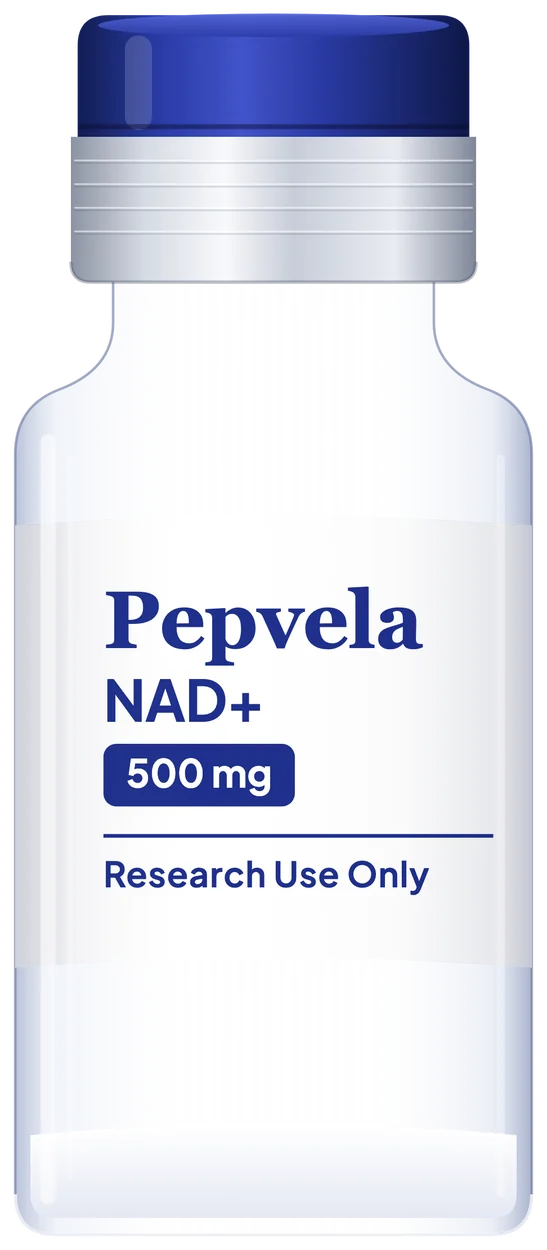
NAD+ 500mg
500mg vial
$65
In stockNAD+ (Nicotinamide Adenine Dinucleotide) is a coenzyme found in all living cells, central to cellular energy metabolism and mitochondrial function. It is associated with redox balance and cellular-aging pathways.
- Certificate for this exact product and strength not yet published. Testing & COAs
- Ships within 1–2 business days after payment
- Free U.S. shipping over $200
- Research use only. Not for human or veterinary use.
Placed as an order request; no payment is taken at checkout. Payment instructions follow review.
Specifications
| CAS Number | 53-84-9 |
| Molecular Formula | C21H27N7O14P2 |
| Molecular Weight | 663.4 g/mol |
| Appearance | White to off-white lyophilized powder |
Storage. Keep at -20C, protected from light and moisture. Keep sealed until ready for controlled handling.
Research summary
NAD+ is a coenzyme central to redox reactions and cellular energy metabolism. It is commonly discussed in connection with mitochondrial function, DNA-repair-related pathways, and age-associated cellular processes.
Certificate of Analysis
Certificate for this exact product and strength not yet published. A certificate is linked to a product only when its compound and strength match exactly.
View published certificates or contact Pepvela to ask about documentation for this product.
Shipping
- Orders are placed as order requests. Payment instructions (card payment link, Zelle or Venmo) follow review.
- Orders are processed within 1–2 business days after payment is confirmed.
- U.S. orders ship for a flat $10, free over $200.
- International shipping is quoted per order.
- Tracking is provided when your order ships.
See the Shipping Policy, Returns & Refunds and Payment & Billing.
Product FAQ
What is NAD+?
NAD+ 500mg is a larger-format vial of the cellular coenzyme associated with energy metabolism, redox balance, and cellular-aging pathways.
What pathways is NAD+ associated with?
NAD+ is commonly studied in cellular energy systems, mitochondrial function, redox biology, and DNA-repair related pathways.
What do studies typically examine?
Studies typically examine how NAD+ relates to cellular energy transfer, mitochondrial signaling, and age-associated cellular processes.
How should this product be stored?
Keep at -20C, protected from light and moisture. Keep sealed until ready for controlled handling.
What is a COA?
A Certificate of Analysis, or COA, summarizes quality-control details for a material. It may include identity, purity, appearance, molecular weight, batch or lot information, and testing method details when available.